


History Presentation: Bombing Japan
Doors Open 9:00 a.m. Presentation Begins 10:00 a.m.
Even before Dec. 7, 1941, the Army Air Forces were planning a strategic bombing campaign against Japan should war come. However, Japan’s quick conquest of the Philippines and Pacific islands and occupation of eastern China made that impossible with the bombers available at that time. The long-range B-29 Superfortress was in development, but its advanced design slowed production far behind initial estimates. Even as B-29s were initially fielded in May 1944, technical and logistics issues delayed their effective use. Operation Matterhorn, B-29s bombing of Japan from China, proved ineffective because of supply and other issues. The strategic bombing campaign began in earnest in late 1944 with the arrival of B-29s on the newly captured Marianas islands of Guam, Tinian, and Saipan. The B-29s could fly the 3,000-mile round-trip missions. The campaign was complicated by the nature of Japanese war materials production as many small factories were widely spread among residential areas in Japan’s main cities.
Initial high-altitude bombing missions from the Marianas proved ineffective due to very strong high-altitude jet stream winds over Japan which made accurate bombing difficult. Tactics were eventually changed to employ lower altitudes using incendiary bombs. On the nights of March 9 and 10, 1945, 279 B-29s dropped 1,665 tons of mostly incendiaries on Tokyo from 2,000 feet. The individual fires caused by the bombs joined to create a conflagration. About 16 square miles of the city were destroyed and 100,000 people likely died. The bombings reduced Japan’s war materials production significantly. Still, the Japanese would not surrender. To stop the war quickly and save both Allied and Japanese lives, B-29s dropped atomic bombs on the military-heavy city of Hiroshima on Aug. 6, 1945, and days later the city of Nagasaki. Soon after, Japanese leaders accepted the terms of unconditional surrender. The strategic bombing of Japan ended the war. Controversy about the use of fire bombing and atomic weapons continues today.
On Saturday, Nov. 14, at 10:00 a.m., museum docent Matt Ouding will present the full story of the strategic bombing of Japan.
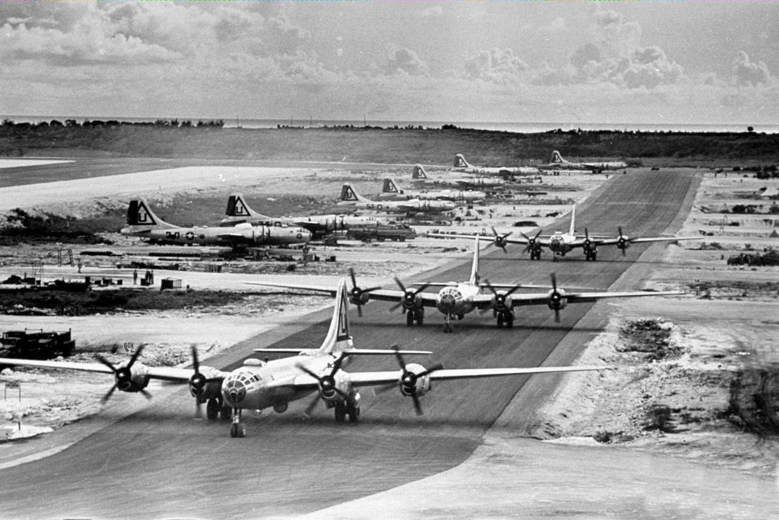
B-29 Superfortress bombers on the island of Tinian lining up for takeoff for a target in Japan.